
Troubleshooting and Repair: Find the Real Problem, Fix It Once
Our most common calls: a breaker that keeps tripping, an outlet that stopped working, a smoke detector that will not stop chirping. Here is what to do right now, what happens when we come out, and how we price it.
The price is quoted before we start, and it covers the whole circuit, not one guess.
Before you call: three things worth checking
We would rather not charge you a diagnostic to push a button. Three checks that solve a surprising number of calls:
- The reset button. Bathroom, kitchen, garage and outdoor outlets are often protected by one GFCI outlet with a reset button on its face. If several outlets died at once, find it and press reset.
- The wall switch. Many bedrooms and living rooms have one outlet controlled by a switch. If a lamp works in one outlet and not another, try the switch by the door.
- The breaker. Look for one sitting between on and off. Switch it fully off, then on, once. If it trips again, leave it off and call us. Do not keep resetting it.
That is the whole list. We do not want you opening panels or boxes, and neither does your insurer.
A breaker that keeps tripping is doing its job
People call us to replace a breaker because it will not stay on. Nine times out of ten the breaker is fine. It is opening because something on that circuit is wrong: an overloaded run, a damaged cable, a device that is drawing too much, a splice somebody buried. Replacing the breaker with a bigger one is how houses burn. We find what is on the circuit and fix that. If the panel itself is the problem, that is a panel upgrade, and we will say so.
Same story with outside lights. The fixture is rarely dead. Usually it is the photo eye, the small sensor that turns it on at dusk, and that is a quick repair.
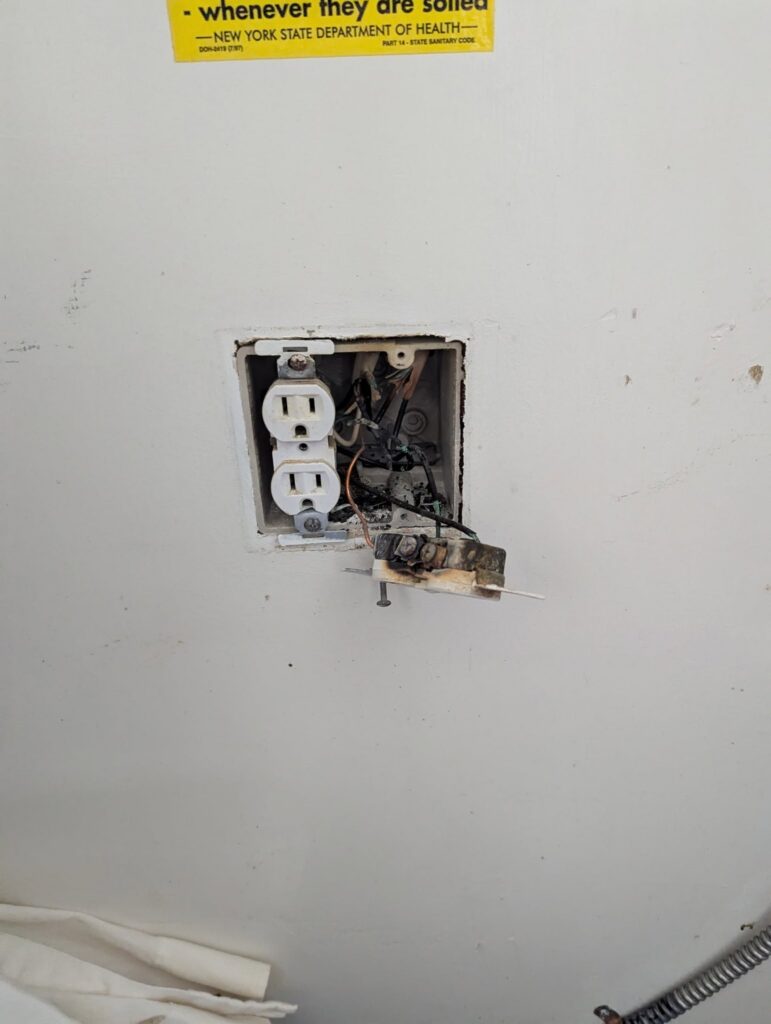
A hot or melted outlet: unplug it, stop using it, call
A receptacle that is warm, discolored, buzzing or smells like plastic is a fire in slow motion. Unplug whatever is in it, do not use it, and if you can find the breaker, turn that circuit off. Then call. We treat these as priority calls.
A smoke detector that keeps chirping after a fresh battery is usually past its expiration date, and a new battery will not fix it. It has to be replaced. Do not leave a room without a working detector; if it has to come down, it goes back up the same day.
What the diagnostic covers
Troubleshooting is quoted before we start. That diagnostic covers the whole circuit, not one guess, and most of the time it includes the repair itself when the fix is a single device: a receptacle, a switch, a fixture.
One honest exception. We can only diagnose as far as current will travel. If we repair the fault and something a previous owner added further down the circuit is still causing trouble, chasing that is additional work. Roughly nine times out of ten it never comes up, and we tell you before we do anything.
What we will not do is put a Band-Aid on it. Taping up a splice or bypassing a bad run so this works and that does not is how we end up back at a house a month later. If the only job available is a Band-Aid, we would rather not have the job.
One promise worth knowing about. If we test the power as part of the diagnostic and tell you it is good, and it turns out it is not, we do not charge you extra for finding that. If we are going on your word that the power is fine and we hit a break underground, that is a separate diagnostic, which is why we test it instead of assuming.
Can you come today?
Sometimes. We do not keep a technician sitting in the shop waiting for the phone, so we cannot promise same-day arrival. What we can promise is that we schedule one or two calls per technician per day on purpose, so when we do arrive we have the time to finish the job that day instead of scheduling you out four weeks. Members get first call on the schedule.
When we arrive, plan on being home for about an hour. A proper service call includes walking you through what we found and what your options are before anything is decided.
Repair questions we hear most
Why does my breaker keep tripping?
Something on that circuit is pulling more than the wire can safely carry, or a wire is shorting, and the breaker is doing its job. Stop resetting it and call. Never swap in a bigger breaker; that is like taping over a smoke alarm because it keeps going off.
What is the difference between a two prong and a three prong outlet?
The round third hole is the ground. A two prong outlet has no ground wire behind it, which usually means older wiring. Putting a three prong outlet on a wire with no ground is like a seat belt buckle with no belt attached: it looks like protection and it is not. There are code-approved ways to make those outlets safer, and we go over them on an evaluation.
What does grounded mean?
A ground is an extra wire that gives electricity a safe path back to the panel when something goes wrong, like a loose wire touching the metal of an appliance. Think of the overflow drain in a bathtub: nobody notices it until water goes where it should not, then it carries the water away before it reaches the floor. With a ground, the breaker trips right away. Without one, that metal can stay live until someone touches it. Homes wired since the early 1960s have it; many older homes do not.
My smoke detector chirps even with a new battery. Why?
It has most likely reached the end of its life, usually about ten years, and the chirp is how it tells you. Replace the unit. If your detectors are hardwired and connected to each other, replace them as a set so they keep working together.
Do you charge just to come out?
Yes, there is a flat fee for the evaluation visit, and we go over it with you on the phone before we schedule so there are no surprises. A technician comes to your house and spends about an hour looking at the problem you called about and the rest of the home, like a checkup at the doctor. Then we go over what we found, flagged red, yellow or green, from what needs fixing now to what can wait, with a price for anything you want done. If you hire us for the work, in most cases the evaluation fee is rolled into the job price. How our pricing works.
Do I need to be home for the evaluation?
Yes, and we prefer it. An electrician walks through the home with you so you can see what we see. Please set aside about an hour. Some visits run longer, and we will tell you what to expect when you book. If you have to leave halfway, we never get to show you what we found.
Something is not working. Tell us what.
A real person answers, asks the right questions, and tells you what it costs before anyone drives over.